You walk away from a car accident feeling shaken but relatively fine. Perhaps your neck feels slightly tight, but there is no significant pain. Then, one or two days later, you wake up with stiffness, headaches, shoulder discomfort, or difficulty turning your head.
This delayed reaction can be confusing. It may even make you wonder whether the pain is really connected to the accident.
Neck pain and other whiplash-related symptoms do not always appear immediately. Medical sources report that symptoms may begin several hours or days after a collision. In some cases, the full extent of the discomfort becomes noticeable only after the person returns to normal activities.
Understanding why this happens can help you recognize symptoms, avoid aggravating an injury, and seek an appropriate evaluation.
What Happens to Your Neck During a Car Accident?
A collision can expose the neck to rapid acceleration and deceleration. The head may move backward, forward, or from side to side while the torso is restrained by the seat belt.
Whiplash commonly refers to the forceful back-and-forth movement of the neck that can occur during a rear-end collision. This motion can place stress on the muscles, ligaments, joints, and other tissues that support the cervical spine.
The injury does not have to produce immediate, severe pain. The tissues may already be irritated or strained even though the symptoms have not fully developed.
Why Can Neck Pain Be Delayed After an Accident?
Several factors may contribute to delayed neck pain.
The Body’s Inflammatory Response Takes Time
When muscles, ligaments, or joints are strained, the body begins an inflammatory response. Swelling, tenderness, stiffness, and sensitivity can gradually increase over the hours following the accident.
This is one reason someone may feel manageable soreness immediately after a crash but considerably more discomfort the following morning.
Muscle Tightness and Spasms May Develop Gradually
Muscles around the neck and shoulders may tighten to protect an injured area. This protective response is sometimes called muscle guarding.
As the muscles remain tense, you may begin to notice:
Difficulty turning your head
Tightness across the shoulders
Pain near the shoulder blades
Discomfort that worsens after sitting or driving
Headaches beginning near the base of the skull
Muscle spasms and stiffness can become more noticeable several hours after the original injury.
The Initial Stress of the Accident Can Distract From Symptoms
Immediately after a collision, your attention may be focused on checking passengers, speaking with police, exchanging insurance information, arranging transportation, or dealing with vehicle damage.
Mild discomfort may not seem important during the confusion. Once the immediate situation settles and you begin moving normally again, the symptoms can become easier to recognize.
Normal Activities Can Aggravate an Injured Area
Returning to work, looking at a computer, driving, lifting objects, exercising, or sleeping in an awkward position may place additional stress on already irritated tissues.
The activity did not necessarily create the original injury. It may simply make the effects of the collision more noticeable.
What Are Common Delayed Whiplash Symptoms?
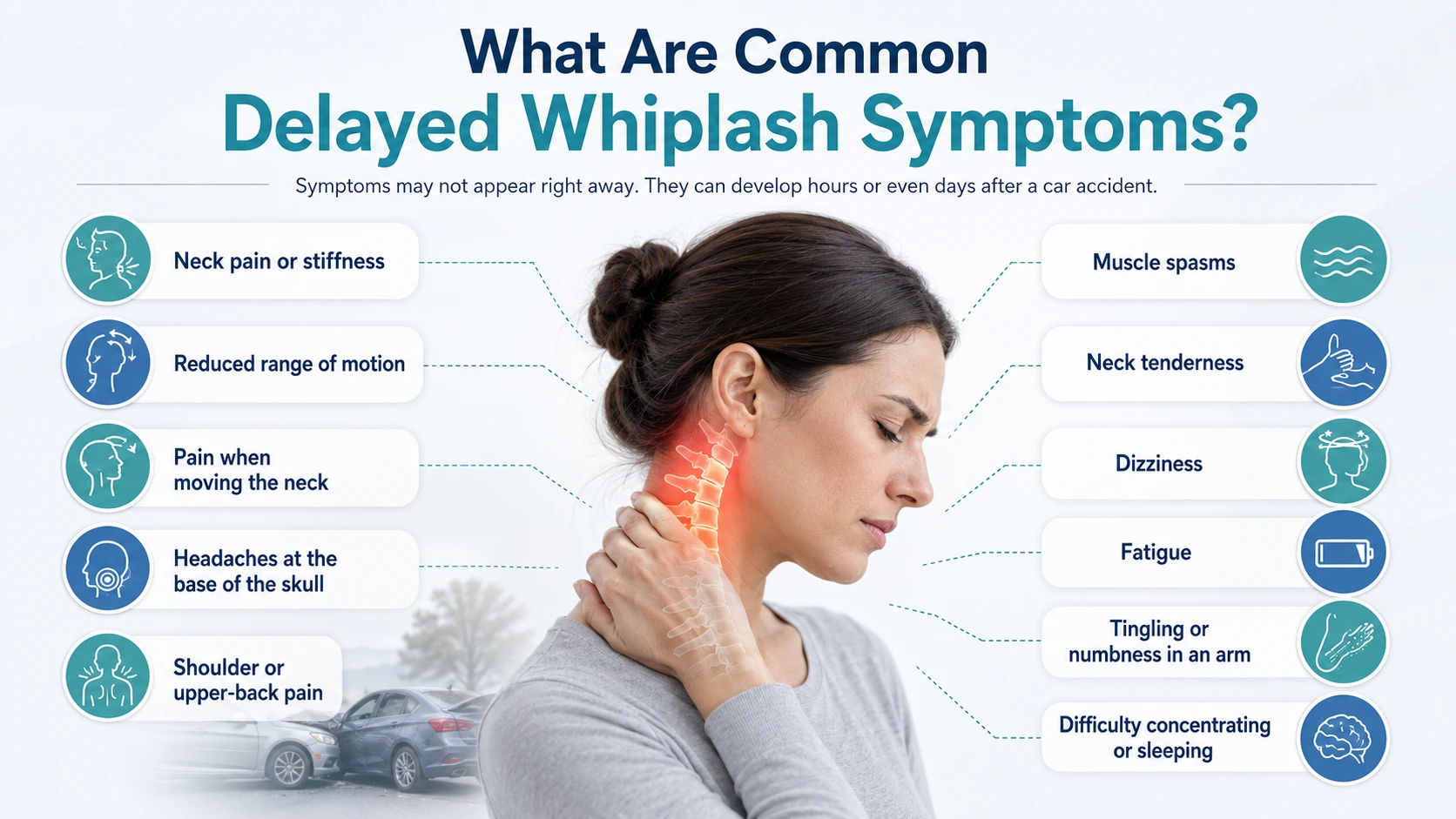
Neck pain is one of the most recognized symptoms, but it is not the only one. Symptoms associated with whiplash may include:
Neck pain or stiffness
Reduced range of motion
Pain that increases when moving the neck
Headaches, particularly near the base of the skull
Shoulder or upper-back pain
Muscle spasms
Tenderness around the neck
Dizziness
Fatigue
Tingling or numbness in an arm
Difficulty concentrating or sleeping
Some symptoms may start immediately, while others may take 12 hours, a full day, or several days to appear.
Because these symptoms can also occur with conditions other than whiplash, an examination is important when discomfort develops after an accident.
Does Delayed Pain Mean the Injury Is Serious?
Not necessarily. Many whiplash injuries are minor and improve with appropriate care and time. However, the timing or intensity of pain cannot determine the seriousness of the injury by itself.
Neck pain after a collision can involve muscles and ligaments, but healthcare professionals may also need to rule out fractures, disc injuries, nerve irritation, concussion, or other complications.
Imaging does not always show the soft-tissue changes associated with whiplash, but X-rays, CT scans, or MRI scans may be used when necessary to rule out other injuries.
That is why delayed symptoms should not automatically be dismissed simply because you felt fine at the accident scene.
When Should You Seek Emergency Medical Care?
Call 911 or seek emergency medical attention following a car accident if you experience:
Severe or rapidly worsening neck pain
Weakness, numbness, or loss of coordination
Difficulty walking or maintaining balance
Loss of bladder or bowel control
Trouble breathing
Repeated vomiting
Increasing confusion or unusual behavior
Slurred speech
A worsening headache that does not go away
Seizures
Extreme drowsiness or difficulty waking up
Loss of consciousness
These symptoms may indicate a spinal cord injury, concussion, or another condition requiring immediate evaluation.
Chiropractic care is not a substitute for emergency treatment when red-flag symptoms are present.
Why Is an Early Evaluation Important?
An early evaluation can help determine which tissues may be involved and whether additional medical testing or referral is needed.
During an assessment, the provider may review:
How the collision occurred
When the symptoms started
Where the pain is located
Whether pain travels into the shoulders or arms
Neck range of motion
Muscle tenderness and tightness
Strength, sensation, and reflexes
Previous neck injuries or conditions
Activities that make the symptoms better or worse
This information helps the provider develop an appropriate care plan rather than treating every post-accident neck complaint the same way.
An evaluation also creates a clear clinical record of when the symptoms began, how they have changed, and what findings were identified.
How Can Chiropractic Care Support Recovery?
Once serious or unstable injuries have been ruled out, chiropractic care may be considered as part of a broader recovery plan.
Treatment should be based on the individual examination rather than automatically beginning with a spinal adjustment. Depending on the injury, a care plan may include:
Gentle chiropractic techniques
Mobility and range-of-motion exercises
Physiotherapy
Soft-tissue or massage therapy
Posture and movement guidance
Progressive strengthening exercises
Recommendations for modifying work or daily activities
Referral for imaging or additional medical care when appropriate
Research regarding chiropractic treatment for whiplash is not conclusive in every case. However, some evidence suggests that chiropractic care may provide pain relief when combined with appropriate exercise or physical therapy.
The goal should be to support safe movement, reduce discomfort, restore function, and help the patient return to normal activities without using a one-size-fits-all approach.
Should You Keep Your Neck Completely Still?
Unless a healthcare professional has told you otherwise, prolonged immobilization is generally not considered the preferred approach for routine whiplash recovery.
Keeping the neck still for too long can reduce muscle strength and may slow recovery. Gentle, guided movement and appropriate exercises are often included in treatment, although the correct timing and intensity depend on the individual injury.
Avoid forcing the neck through sharp pain or attempting aggressive stretches without professional guidance.
Can You Have Whiplash Without Severe Vehicle Damage?
The appearance of the vehicle alone does not provide a complete diagnosis of what happened to a passenger’s neck.
Vehicle position, direction of impact, seat and headrest placement, body position, previous injuries, age, and other factors can affect how a person responds to a collision.
Rather than assuming that a low-damage accident could not cause symptoms, pay attention to changes in pain, movement, headaches, sleep, and neurological symptoms during the following days.
What Should You Do if Neck Pain Starts Days Later?
If neck pain develops after a car accident:
Do not ignore the connection simply because the pain was delayed.
Avoid activities that clearly worsen the pain.
Do not forcefully stretch or manipulate your own neck.
Record when the symptoms began and how they are changing.
Seek emergency care for severe or neurological symptoms.
Arrange a professional evaluation for persistent pain, stiffness, headaches, or reduced movement.
Mayo Clinic recommends seeing a healthcare professional when neck pain or other whiplash symptoms develop after an accident so that fractures and other potentially serious damage can be ruled out.
Get Neck Pain Evaluated in Columbus, Ohio
Delayed neck pain after a car accident is real, and it should not be dismissed just because you initially felt fine.
Town and Country Chiropractic provides care for patients experiencing neck pain, stiffness, headaches, whiplash symptoms, and other problems following auto accidents. Our Columbus clinic offers chiropractic care along with physiotherapy, massage therapy, rehabilitation exercises, diagnostic services, and gentle “non-popping” techniques when appropriate.
Every accident and every patient is different. Our team will assess your symptoms and determine whether chiropractic treatment is appropriate or whether additional medical evaluation is needed.