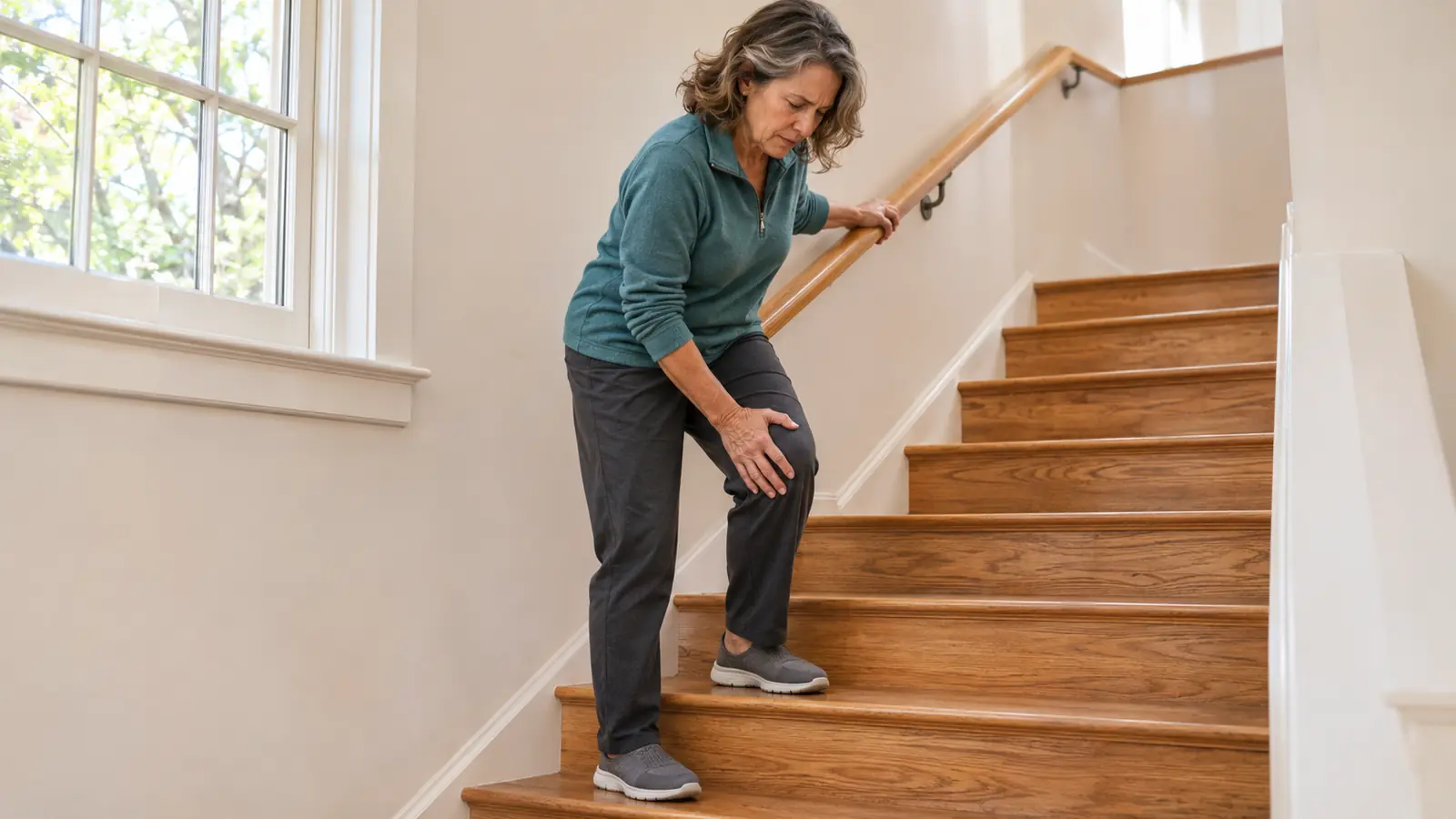
You can walk across the room comfortably, but the first step down to the basement makes your knee ache. A few steps later, you’re leaning on the handrail or taking the stairs one at a time. When flat ground feels fine, it’s easy to wonder what the stairs are doing differently.
Stairs make your knee bend while it supports your weight. That can bring out symptoms from the kneecap, a nearby tendon, or another part of the joint. Where the pain sits, how it started, and whether the knee swells or catches can help you decide when to get it checked.
Why stairs can hurt when walking feels fine
On the way up, the muscles at the front of your thigh help push you onto the next step. On the way down, those muscles help control how you lower yourself. The knee bends under load in both directions, and the joint behind the kneecap generally takes more force on stairs than during level walking.
A single step can feel manageable even when a full flight leaves your knee sore. Carrying groceries adds to the weight your knee has to support, and a taller step can make you bend the joint farther. Those details can explain why some trips are harder than others.
Common causes of knee pain on stairs
A dull ache around or behind the kneecap. Patellofemoral pain often builds gradually and can show up on stairs, during squats, or after sitting with your knee bent for a long time. You might notice it after adding more running, jumping, or other activity that repeatedly loads the knee.
A tender spot just below the kneecap. The patellar tendon connects your kneecap to your shinbone. Repeated jumping or running can irritate it. Early on, the pain may be noticeable during or after a workout. As it becomes more bothersome, it can show up when you climb stairs or rise from a chair.
Stiffness and aching after you’ve been still. Knee osteoarthritis can make the joint feel stiff when you first get out of bed or stand up after sitting. The knee may also ache with activity or feel puffy. Stairs may be one of several activities that are harder on those days.
Pain along the inside or outside of the knee after a twist. The meniscus is a pad of cartilage that helps cushion the knee. A tear can cause pain, swelling, or a catching sensation. Some people notice the swelling later or find it hard to straighten the knee fully. These symptoms are worth mentioning if you get examined.
What to notice about your knee pain
Imagine your knee begins to ache near the kneecap after a week of taking extra flights at work. You can walk comfortably, but squatting and going down steps bring back the ache. Compare that with twisting your knee on a step, then noticing swelling and a feeling that it catches when you turn. Those histories would lead a clinician to ask different questions.
If the pain keeps coming back, a few details can help at an appointment.
- Point to where you feel it. Is it concentrated in a small spot, spread around the kneecap, or along one side of the joint?
- Notice when it starts. Does it happen on the first step, after repeated trips, or after you sit for a while?
- Think back to a change in activity, a twist, or a fall. Note when you first noticed swelling, if it occurred.
- Tell the clinician if the knee catches, gives way, or feels stuck when you try to straighten it.
What you can try if the pain is mild
If the pain came on gradually, stays mild, and you can walk comfortably, reduce the stair trips or activities that repeatedly bring it on for a few days. Use the handrail and take the stairs at a pace you can control. Carry smaller loads if that makes trips easier. If deep squats or a stair workout reliably provoke the pain, try a shorter walk on level ground or another comfortable activity while it settles.
Notice how your knee feels later that day and during the next few trips. If it feels better with fewer stairs, add them back gradually. If the knee is mildly swollen, a cold pack wrapped in a towel for up to 20 minutes can help ease discomfort. Increasing swelling, trouble walking, or a knee that feels unstable are reasons to get advice.
When to get your knee checked
Seek urgent medical care if you can’t put weight on the leg, your knee locks and you can’t straighten it, or you have severe pain, marked swelling, or a change in the shape of the knee after an injury. Get urgent care for a hot, swollen knee as well, especially if you have a fever, chills, or feel unwell. A joint infection needs prompt treatment.
Schedule an evaluation if pain keeps getting worse, makes everyday activities difficult, or hasn’t improved after a few weeks. If you’re changing how you walk, avoiding stairs at work, or cutting back on exercise because the pain keeps returning, tell the clinician what you’ve already tried and how your knee responded.
What happens during a knee evaluation
A clinician may check for swelling and tenderness, see how well you can bend and straighten the knee, and assess whether it feels stable. If appropriate, they may watch you walk, squat, or step up to see which movement brings on the pain. The history and exam help determine whether imaging or another evaluation would be useful.
The next step depends on what the exam shows. If the cause is patellofemoral pain, rehabilitation usually includes exercises to strengthen the knee and guidance on adjusting activity. Hip exercises can be added when appropriate. Your plan can also address a practical goal, such as using the stairs at home more comfortably or getting back to the exercise you enjoy.
Help with recurring knee pain in Columbus
If stairs are regularly bringing on knee pain, our team at Town and Country Chiropractic can help you decide whether an evaluation at our office is appropriate for your symptoms.
Call (614) 238-1111 to reach us at 3894 E Broad St., Columbus, OH 43213. Contact our office