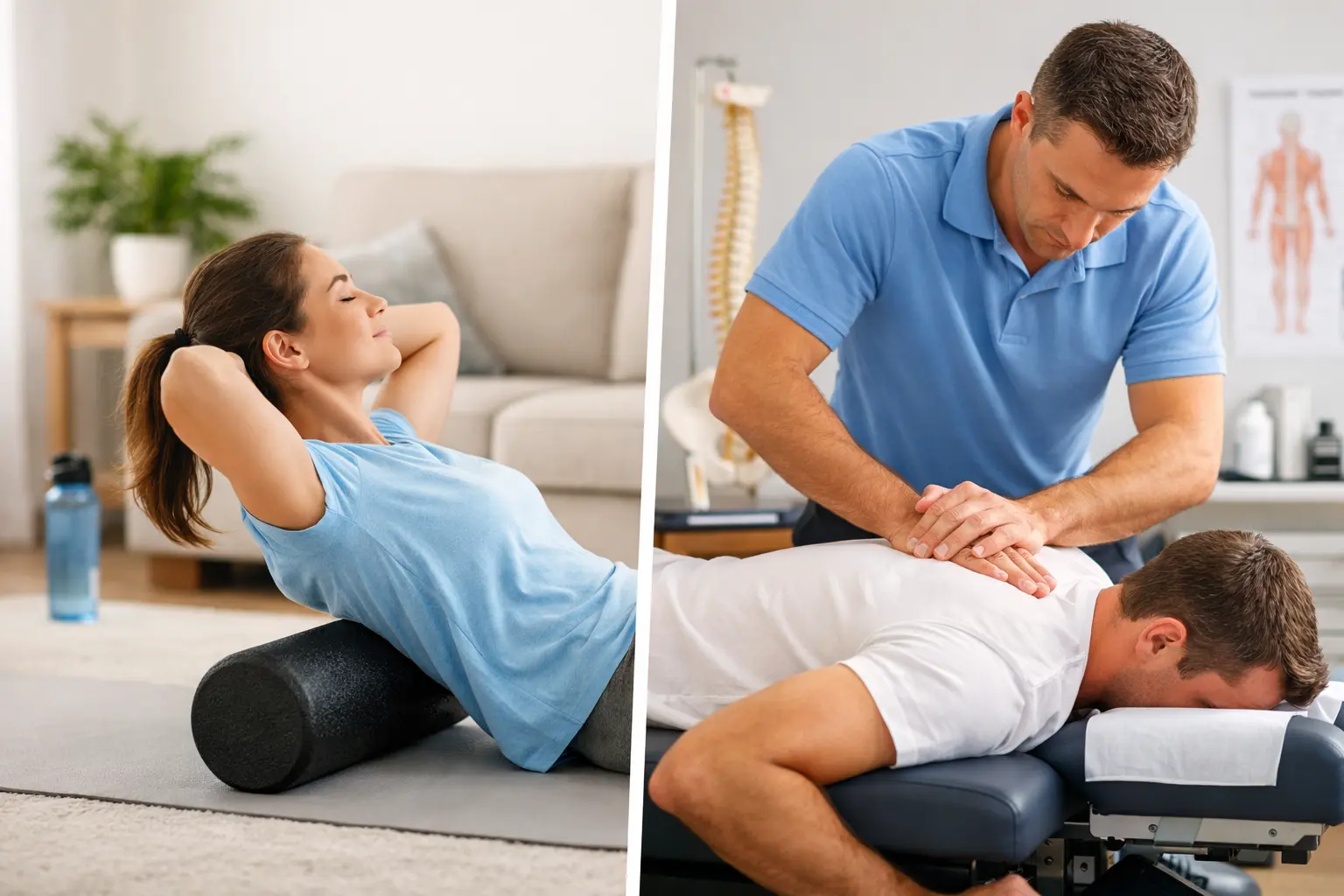
Your lower back hurts. Then you notice discomfort in your buttock. Maybe there is a strange tingling sensation running down your leg.
Is it ordinary lower back pain, or could it be sciatica?
The two are often confused because sciatica can include lower back pain. But they are not the same thing. Lower back pain describes pain located primarily in the lumbar area, while sciatica typically involves irritation or compression of nerves that produce symptoms traveling from the lower back or buttock into the leg.
Understanding the difference can help you recognize when your symptoms may involve more than sore muscles or joints and when it is time to have them professionally evaluated.
What Is Lower Back Pain?
Lower back pain refers to discomfort in the lumbar region, the area between the bottom of your rib cage and your pelvis.
It can appear suddenly after lifting something, bending awkwardly, exercising, or making a quick movement. It can also develop gradually after sitting for long periods or repeatedly stressing the lower back.
The pain can feel different from person to person. It may be:
- Dull or aching
- Sharp
- Stiff or tight
- Worse when bending or changing positions
- Accompanied by muscle spasms
- Better or worse depending on your posture
Acute lower back pain is commonly associated with strain or injury involving the muscles and ligaments supporting the back, although many different conditions can produce back pain.
Most importantly, ordinary lower back pain does not necessarily involve a nerve.
What Is Sciatica?
Sciatica describes symptoms associated with irritation or compression involving the nerve roots that contribute to the sciatic nerve.
The sciatic nerve pathway extends from the lower back through the buttock and down the leg. When those nerve roots are affected, symptoms may travel along a similar route.
This is the characteristic difference.
Instead of discomfort remaining mainly in the lower back, sciatica may cause pain that travels from the lower back or buttock into the thigh, calf, foot, or toes. It frequently affects one side of the body.
Sciatic symptoms can include:
- Shooting or radiating leg pain
- Burning pain
- Tingling or a “pins and needles” sensation
- Numbness
- Leg or foot weakness
- Pain extending through the buttock and down the back of the leg
Some people describe the pain as an electric shock or jolt. Sitting for long periods, coughing, or sneezing can sometimes make symptoms worse.
The Simplest Way to Think About the Difference
Imagine two people both saying, “My lower back hurts.”
The first person has soreness concentrated across the lower back after moving furniture. The muscles feel tight, bending is uncomfortable, but there is no tingling, numbness, or pain traveling down the leg.
That pattern may be more consistent with localized lower back pain.
The second person feels discomfort in the lower back, but the pain also travels through one buttock and down the back of the thigh. The calf occasionally tingles, and part of the foot feels numb.
That pattern raises more suspicion for sciatica or another condition affecting a nerve.
The location of your pain is important, but what the pain does may be even more informative.
Sciatica vs. Lower Back Pain: Key Differences
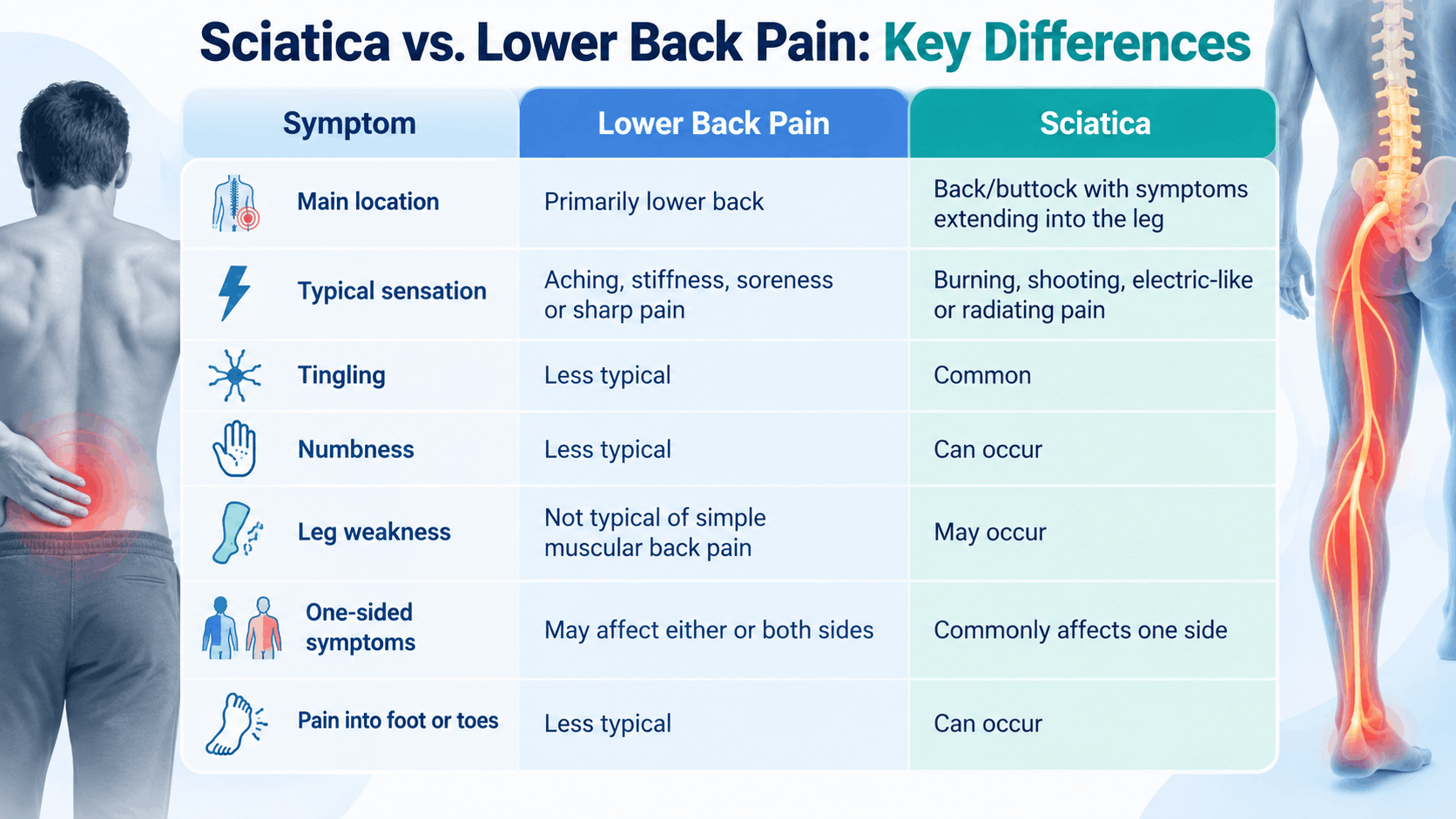
Symptoms alone cannot establish the diagnosis, but these patterns can help determine what should be evaluated.
What Causes Sciatica?
Sciatica is a symptom rather than a single disease.
One of the most common causes is a herniated spinal disk that places pressure on a nerve root in the lower spine. Bone overgrowth associated with degenerative changes and spinal stenosis can also contribute to nerve compression.
This is also why simply describing all radiating leg pain as a “tight muscle” can be misleading.
A healthcare professional may evaluate your movement, strength, sensation, reflexes, pain pattern, medical history, and other findings to determine whether nerve involvement is likely.
Does Sciatica Always Cause Back Pain?
No.
Although sciatica can begin in the lower back, some people experience much stronger symptoms in the buttock or leg than in the back itself.
You might have relatively mild lower back discomfort but significant burning, tingling, or shooting pain farther down the leg.
That is one reason people sometimes assume they have a hamstring, hip, or leg problem when the source of the symptoms may actually involve a nerve originating in the lower spine.
Does Leg Pain Automatically Mean Sciatica?
Not necessarily.
Pain can travel into the hip or leg for several reasons. Muscles, joints, tendons, nerves, and other structures can produce symptoms that overlap.
Determining whether the problem actually involves the sciatic nerve or lumbar nerve roots generally requires more than identifying where it hurts.
A proper assessment may include checking:
- How the back and hips move
- Whether certain movements reproduce symptoms
- Muscle strength
- Sensation
- Reflexes
- Whether symptoms travel farther down or retreat toward the back with certain positions
In some cases, additional medical evaluation or imaging may be appropriate. However, imaging is not routinely necessary for every episode of lower back pain or sciatica. NICE guidance recommends imaging primarily when the result is expected to change how the condition is managed.
Can Chiropractic Care Help With Lower Back Pain?
Chiropractic care is one conservative option that may be considered for some types of lower back pain.
Spinal manipulation has been studied as a nondrug treatment for both acute and chronic lower back pain. The National Center for Complementary and Integrative Health reports that spinal manipulation may provide small improvements in pain and function for some patients.
Treatment should be based on the individual patient rather than assuming everyone with back pain needs the same adjustment.
Depending on your examination, chiropractic care may involve manual treatment, mobility work, exercise recommendations, rehabilitation, soft-tissue treatment, and advice about activities that may be aggravating the problem.
What About Chiropractic Care for Sciatica?
Sciatica requires a little more care because nerve symptoms are involved.
Research on spinal manipulation specifically for sciatica is more limited than research for nonspecific lower back pain. NCCIH notes that some evidence suggests manipulation may help certain patients with sciatica, but the available research has limitations.
For this reason, the important first step is determining what appears to be producing the symptoms and whether conservative treatment is appropriate.
Current NICE guidance recommends that manual therapy, including spinal manipulation, mobilization, or soft-tissue techniques, be considered for lower back pain with or without sciatica as part of a broader treatment package that includes exercise, rather than as an isolated treatment.
That distinction matters.
The objective should not simply be to “adjust the pain away.” A treatment plan may also need to address movement, strength, mobility, posture, activity tolerance, and other contributing factors.
When Should You Seek Medical Attention?
Most episodes of lower back pain are not medical emergencies, and many cases of sciatica improve with conservative care.
However, certain symptoms require prompt medical attention.
Seek immediate medical care if back or sciatic-type pain occurs with:
- New difficulty controlling your bladder or bowels
- Sudden or significant weakness in a leg
- Significant loss of sensation
- Severe symptoms following a major accident or traumatic injury
- Rapidly worsening neurological symptoms
Mayo Clinic specifically advises immediate medical evaluation for sciatica involving sudden leg numbness or weakness, loss of bowel or bladder control, or symptoms following a violent injury.
These are not symptoms to simply “work through.”
Pay Attention to Where the Pain Travels
If your discomfort stays mainly across your lower back and feels sore, stiff, or achy, you may be experiencing localized lower back pain.
If the discomfort travels through your buttock and down one leg, particularly when accompanied by tingling, numbness, burning sensations, or weakness, nerve involvement such as sciatica becomes more likely.
But symptoms can overlap, and trying to diagnose the problem based only on where it hurts can be difficult.
At Town and Country Chiropractic in Columbus, Ohio, we evaluate back, hip, and leg symptoms to help determine what may be contributing to your discomfort and whether chiropractic and conservative care are appropriate.
Our Columbus facility offers chiropractic care along with physiotherapy, massage therapy, rehabilitation exercises, and other services that may be incorporated into an individualized treatment approach.